
Find the Right Tiling Expert
Get support for full installations, pattern designs, or fixing damaged tiles.
Vetted Tradespeople
Free Quotes
Quick Turnaround
.png)

New Feature
Not sure which
service you need?
Our AI Trade Assistant can help you scope your project, estimate costs, and understand the technical jargon before you talk to a human.
How much does a split AC unit cost to install?
For a single room split system in the UK, you can expect to pay between £1,500 and £2,500 depending on the brand and complexity.
Expert Tips & Style Guides

Expert Guide
7 Things No One Tells You About Choosing Bathroom Tiles
Planning a bathroom renovation often starts with a dream—a vision of a spa-like sanctuary, with gleaming fixtures and, most importantly, beautiful tiles that define the space. We scroll through images of intricate patterns and luxurious finishes, imagining a perfect retreat. But the path from showroom sample to a stunning, functional bathroom is paved with technical realities many homeowners are never told about.
Without an understanding of the material science and installation standards that underpin a successful project, you risk turning your dream space into a source of long-term frustration. Choosing tiles based on looks alone can lead to catastrophic failures, from cracked floors to hidden structural damage. This guide reveals the surprising truths that will help you choose wisely, protect your investment, and build a bathroom that is as durable as it is beautiful.
1. Your "Waterproof" Tiles Aren't Actually Waterproof
The single most dangerous misconception in bathroom renovation is that tiles and grout are waterproof. The non-negotiable technical reality is that they are not. While materials like porcelain are highly water-resistant, the real protection against leaks and structural damage comes from the dedicated waterproofing system, or "tanking," applied to the substrate before a single tile is laid.
As stated in the Expert Report on Tiler Services and mandated by UK Building Regulations for wet rooms, this unseen membrane is the only true barrier. Water will eventually penetrate porous grout lines and microscopic cracks. Without a proper waterproofing system underneath, this moisture seeps into the structure, leading to mould, wood rot, and catastrophic tile delamination. The tile is the finish, but the waterproofing is the protection.
"Tiles alone are not waterproof—water can penetrate through grout lines and cracks, damaging underlying structures. Proper waterproofing creates a barrier that stops leaks before they become an issue."
2. Bigger Tiles Can Make a Small Bathroom Look Huge (But There's a Catch)
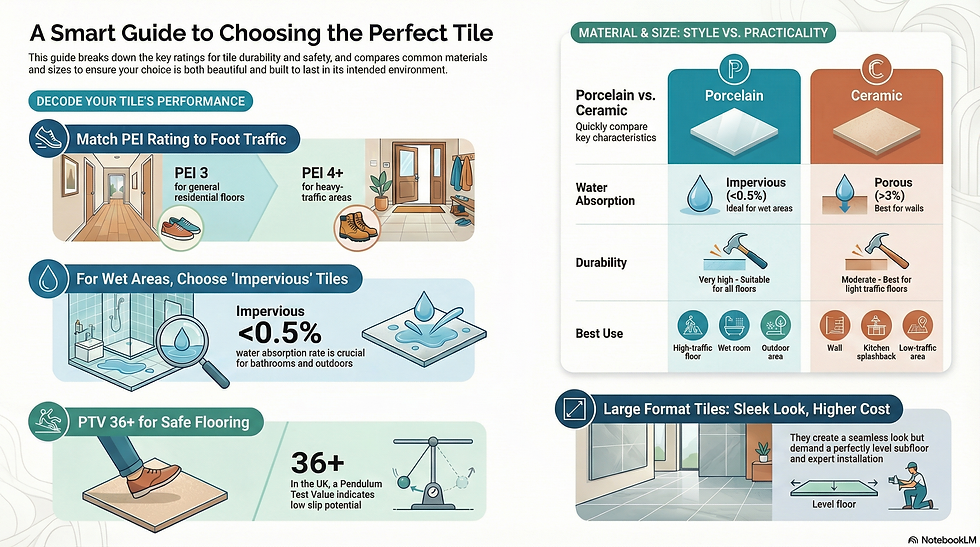
It’s a popular designer trick: using large format tiles (LFTs) to make a small bathroom feel more spacious. With fewer grout lines breaking up the visual field, LFTs create a clean, seamless surface that gives the illusion of a bigger, more luxurious space.
But here’s the catch no one mentions in the showroom. The Expert Report on Tiler Services confirms that opting for LFTs comes with a "guaranteed triple-cost surcharge" stemming from three non-negotiable requirements:
Specialist Materials: LFTs are heavy and demand stronger, more expensive adhesives specifically formulated to handle their weight and prevent failure.
Increased Waste: In the characteristically smaller, awkward layouts of many UK bathrooms, large tiles require significant cutting. This frequently leads to much higher material wastage.
Mandatory Preparation Labour: LFTs are brutally unforgiving. They demand a perfectly smooth, level, and structurally sturdy substrate. Achieving this adds significant labour costs for levelling compounds and subfloor reinforcement. This isn't just about aesthetics; a perfectly level substrate is also a prerequisite for the integrity of the waterproofing system beneath it.
3. Porcelain and Ceramic Are Not Interchangeable
In the showroom, porcelain and ceramic tiles can look almost identical. But their performance in a high-moisture bathroom environment is radically different, and choosing the wrong one is a critical error.
The decisive factor is the water absorption rate. Porcelain is forged from finer, denser clay fired at extreme temperatures, making it "impervious" with an absorption rate of less than 0.5%. This is not just a feature; it's a technical requirement for wet room floors. In stark contrast, standard ceramic tiles are far more porous, with water absorption rates that can exceed 7% and sometimes reach as high as 12-18%. This makes them fundamentally unsuitable and non-compliant for any wet floor application where moisture ingress will lead to failure. Porcelain is also significantly denser and more durable, while ceramic is softer and more prone to chipping. For a bathroom, choosing porcelain is an essential decision for longevity.
4. Thickness Doesn't Equal Strength
It’s an intuitive but incorrect assumption: a thicker, heavier tile must be stronger. While thickness contributes to a tile’s breaking strength, it is not the primary measure of its ability to withstand the daily grind of foot traffic.
The industry standard for measuring a tile's resistance to abrasion is the Porcelain Enamel Institute (PEI) rating. This scale classifies tiles based on their glaze hardness, from Class 1 (walls only) up to Class 5 (heavy commercial use). For most residential bathroom floors, a tile with a PEI rating of Class 3 is the standard. For a high-traffic family bathroom, Class 4 offers superior durability.
"The PEI rating assesses a tile's resistance to abrasion, not its thickness. Thicker tiles are not necessarily more durable; always check the PEI rating to ensure the tile meets your needs for wear resistance."
So, when you're choosing a floor tile, ignore its weight in your hand and find the PEI rating on the box—it's the only measure of durability that matters.
5. Grout Isn't Just Filler—It's a Structural Decision
Most homeowners view grout as a simple colour choice. In reality, grout is an engineered structural component, and the joint width is a technical specification, not a style preference.
Grout provides structural integrity by creating a crucial buffer that allows for thermal expansion and minor substrate movement. Without it, tiles would press against each other and inevitably crack. The required joint width is dictated by the tile type, substrate, and location. For example, wet rooms require wider grout joints of 4-6mm. This isn't just about thermal expansion; this specified joint is critical for helping the tiler create the proper slope for drainage, working hand-in-hand with the waterproofing system to prevent water pooling. The desire for minimal grout lines must be balanced with the fundamental engineering requirements of the space.
6. Plywood Is No Longer a Recommended Tiling Base
Outdated DIY advice often suggests plywood as a suitable substrate for tiling. This practice is now explicitly prohibited by modern British Standards (BS 5385-1: 2018) and is a direct route to installation failure.
The reason is simple: wood-based products absorb moisture and move with changes in temperature and humidity. This inherent instability compromises the entire tile installation, leading to cracked grout and loose tiles. As mandated by professional standards, the only acceptable base is a specialist tile backer board. Made from materials like cement or XPS foam, these boards provide a stable, waterproof, mould-resistant base that, unlike plywood, will not degrade when exposed to moisture, ensuring the longevity of your investment.
7. A "Bargain" Tiling Quote Is Your Biggest Red Flag
In any renovation, it’s tempting to accept the lowest quote. But for tiling, a bargain price is the single biggest red flag. The longevity of your bathroom tiles depends almost entirely on the quality of the preparation—the complex, labour-intensive, and expensive work that happens before a single tile is laid.
If you receive a quote that is significantly below the national average, it should be treated as a major warning sign. A price this low is a guarantee that the tiler has omitted critical, non-negotiable steps to cut costs. That rock-bottom price is achieved by ignoring the mandatory waterproofing system detailed in Point #1, skipping the non-negotiable substrate reinforcement required for the large format tiles in Point #2, and using an unsuitable base like the outdated plywood mentioned in Point #6. While the initial result might look acceptable, it creates a near-certainty of catastrophic installation failure in the future.
Conclusion: Beyond the Showroom Sample
Choosing the perfect bathroom tile involves far more than falling in love with a colour or pattern. A successful project demands that you look beyond the surface to understand the technical specifications, installation realities, and material science that ensure your new bathroom stands the test of time.
Investing a little time to understand these crucial details will pay dividends, protecting your home and your budget from costly failures. So, for your next project, will you choose with your eyes or with your intellect? Will you be seduced by the style on the surface, or will you demand the strength in the specs?
Unlock Our Insider Tips and Best Practices
Get the knowledge you need to succeed. Watch our comprehensive video guide filled with essential information and practical tips designed to help you make the most of our services/platform.
✓⃝ Essential information you can revisit anytime
✓⃝ Step-by-step guidance and practical examples
✓⃝ Save time by learning from industry experts
Easily Compare & Book
Describe your tiling needs and we’ll match you with local pros ready to help, quickly and hassle-free.
Wall & Floor Tiling, Repairs & Regrouting
Get support for full installations, pattern designs, or fixing damaged tiles.
Fast, Simple Quotes
Fill in a short form and receive up to 3 competitive quotes so you can choose the right tiler for your space and budget.
Expert Tips & Style Guides
Explore tile options, maintenance advice, and layout inspiration for your next project.
Popular services

Plumber

Electrician

Roofer

Builder

Gardener

Painter

Landscaper

Handyman

Locksmith
What People Are Saying About NearMeTrades
“I posted one job and got three quotes the same day. It saved me so much time!”
John S. (Landlord)
What People Are Saying About NearMeTrades
“It took just 2 minutes to find a tradesperson who came the same day, absolutely brilliant.”
Alex W. (Homeowner)
What People Are Saying About NearMeTrades
“NearMeTrades helped me find a reliable tradesperson within hours, super easy!”
Emily A. (Homeowner)
Guides & How-tos
d78a554d-a037-4652-b8ca-ce0bf5c7c5f3