
Find the Right Driveway Expert
Get professional support for all driveway types, from repairs to decorative new layouts.
Vetted Tradespeople
Free Quotes
Quick Turnaround
.png)

New Feature
Not sure which
service you need?
Our AI Trade Assistant can help you scope your project, estimate costs, and understand the technical jargon before you talk to a human.
How much does a split AC unit cost to install?
For a single room split system in the UK, you can expect to pay between £1,500 and £2,500 depending on the brand and complexity.
Expert Tips & Material Guides


Expert Guide
4 Costly Traps to Avoid When Planning Your New UK Driveway
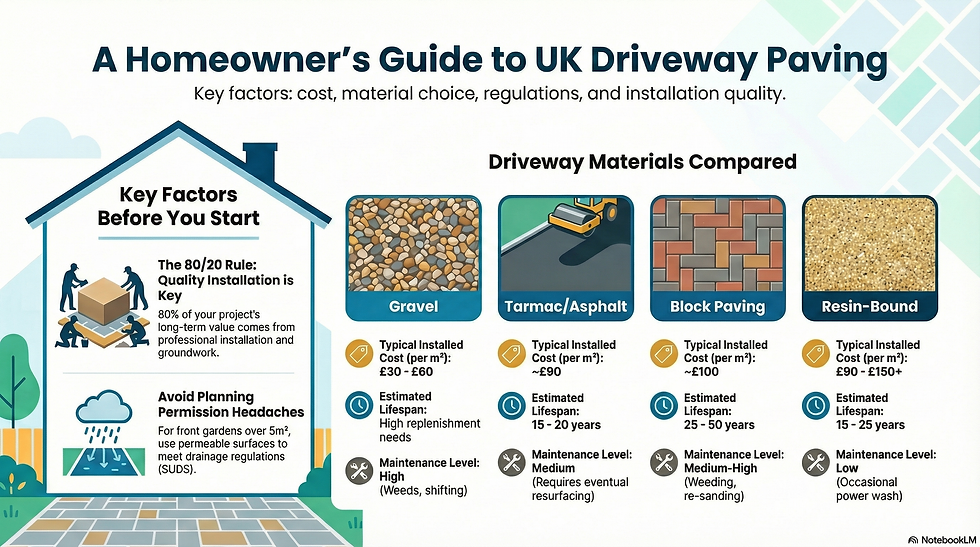
When planning a new driveway, it’s easy to get caught up in the exciting details. Homeowners often spend hours poring over catalogues, choosing the perfect colour of resin or the ideal pattern for block paving. This focus is natural; after all, a new driveway can boost a property's value by 5-10% and completely transform its kerb appeal. However, industry data reveals a crucial, and often overlooked, truth. The most expensive and frustrating mistakes aren't made in the choice of surface material. Instead, they are hidden in the less glamorous but far more critical aspects of a driveway project: the quality of the groundwork, the complexities of UK drainage regulations, the red tape of council permissions, and the financial security of the contractor you hire. These are the areas where a dream project can quickly turn into a costly nightmare. This article cuts through the noise to reveal four surprising takeaways from industry experts. By understanding these common but costly traps, you can shift your focus from simply buying a product to making a wise, long-term investment in your property that is built to last.
1. The 80/20 Fallacy: Your £8,000 Driveway is a £6,400 Bet on Your Installer
The single most common mistake homeowners make is misallocating their budget—both financially and mentally—by focusing on the surface material. Industry analysis, however, reveals a fundamental miscalculation in this approach.
According to experts, a successful, long-lasting driveway project is approximately 80% dependent on the quality of the installation and only 20% on the product itself. This "80/20 rule" means that even the most expensive, premium-grade materials are likely to fail if laid on a poorly prepared foundation. Premature cracking, sinking, and shifting are almost always the result of substandard groundwork, not a faulty surface material.
This insight should fundamentally shift your perspective. A quote for a new driveway is not just a price for a product; it is a management fee for a complex civil engineering project happening on your property. This reframes your role from a consumer to a client hiring a project manager. Your primary concern should be the contractor's process for preparing the sub-base. Demand detailed, written proof of their groundwork specifications, including the planned excavation depth, the specific type of aggregate to be used (such as Type 1 MOT, a specific grade of crushed aggregate certified for creating a stable, load-bearing foundation), and the methods for proper compaction.
2. The "Budget" Driveway Myth: How Tarmac Can Be More Expensive Than Resin
In the UK, a critical piece of legislation known as Sustainable Drainage Systems (SUDS) has significant cost implications for new driveways. The law states that any new or replacement driveway at the front of a property covering more than five square metres must be SUDS compliant. This is to prevent surface water runoff from overwhelming public drainage systems. There are two ways to achieve this:
Use a permeable surface that allows water to drain through it naturally.
Use a non-permeable surface but install a dedicated drainage system (like a soakaway) to manage rainwater within your property's boundary.
This regulation creates what can be described as a "hidden tax on impermeable materials." Standard tarmac, for instance, is often seen as a budget-friendly option with an installed cost of around £90 per square metre. However, because tarmac is non-permeable, choosing it legally triggers the mandatory—and often substantial—cost of installing a separate drainage system. A professionally installed French drain or soakaway can add anywhere from £1,500 to £4,500 to the total project cost.
In contrast, a permeable material like a resin-bound surface has a higher initial cost, averaging around £120 per square metre. Crucially, because it is inherently SUDS compliant, it does not require the additional expense of a separate drainage system. Therefore, homeowners must calculate the total installed and compliant cost to accurately compare materials, rather than relying on the per-square-metre price of the surface alone. The supposedly 'cheaper' impermeable option can become the more expensive choice, even before factoring in its shorter typical lifespan of 15-20 years compared to the 20+ years expected from a resin surface.
3. The Paperwork on the Pavement: Why You Can't Just 'Drop the Kerb'
Creating vehicle access from the road to your new driveway isn't as simple as hiring a builder to lower the kerbstones. Installing a "dropped kerb" is a surprisingly complex and regulated process that involves the local highway authority and potentially separate planning permission. Ignoring these steps can result in being forced to reinstate the kerb at your own expense.
Homeowners must navigate a formal, multi-step process that comes with its own set of costs and conditions:
Formal Application: You must first apply to your local council for permission to create or widen a vehicle crossing.
Non-Refundable Fee: This application comes with a non-refundable assessment fee. For example, Hampshire County Council charges £205.70, while Staffordshire's fee is £137. This is paid simply for the council to assess the site's suitability.
Planning Permission: You may also need separate planning permission if your property is on a classified road (A, B, or C road), is a listed building, or is located within a conservation area.
Accredited Contractors Only: The work can only be performed by contractors who are accredited under the New Roads and Street Works Act (NRSWA). You cannot use a general builder without this specific qualification.
Refusal is Possible: Even after paying the application fee, the council can refuse permission on safety grounds. Common reasons include poor visibility for drivers, the property being too close to a junction or traffic lights, or insufficient space for a vehicle to be parked without overhanging the pavement.
The NRSWA accreditation is a key indicator of a contractor's professionalism. A firm that is not accredited to perform this work is immediately unqualified for the entire project, as they cannot legally provide access to the driveway they are building.
4. The Guarantee That Isn't Guaranteed: The Difference Between a Warranty and Real Protection
Given that the quality of the groundwork accounts for 80% of your driveway's success, a guarantee on that workmanship is your most valuable asset. Most reputable contractors will offer such a guarantee, typically for 5 to 10 years. This provides assurance that defects arising from poor installation will be rectified. But as we'll see, that asset is only secured if it's backed by insurance.
The critical weakness in a standard contractor's warranty is that it is only valid as long as the company that issued it is still trading. This is where homeowners must understand the vital difference between a standard warranty and an Insurance Backed Guarantee (IBG). An IBG is a separate insurance policy that underwrites the contractor's original guarantee. If the contractor's business ceases to trade for any reason—be it insolvency, bankruptcy, administration, or the death of the principals—the IBG policy steps in to honour the original terms of the warranty.
Without an IBG, the risk to the homeowner is significant. This risk is powerfully summarized by insurance experts:
If your chosen installer were to cease trading you could be left with faulty goods, a guarantee of no value and a potential bill to rectify any problem.
Since 80% of your project's success depends on the installation, the guarantee on that work is the most critical asset you are purchasing. An IBG is the only mechanism that truly secures that asset against the primary risk: contractor failure. Demanding one is a non-negotiable step in safeguarding an investment expected to last 20 years or more.
Key Investment Checklist
Before signing any contract, ensure you have clear, written answers to these four essential questions:
What is your detailed specification for the sub-base, including excavation depth and aggregate type? (The 80/20 Fallacy)
Is this quote SUDS compliant, and if not, what is the total cost including the required drainage system? (The "Budget" Driveway Myth)
Are you NRSWA accredited to handle the dropped kerb installation legally? (The Paperwork on the Pavement)
Does your guarantee come with a third-party Insurance Backed Guarantee (IBG)? (The Guarantee That Isn't Guaranteed)
Conclusion: Invest in the Foundation, Not Just the Finish
A successful driveway project is built on more than just attractive pavers or colourful resin. As the data shows, the true value and longevity of your investment are determined by factors that are often invisible at first glance. A robust, well-prepared sub-base is paramount, adherence to UK drainage and access regulations is mandatory, and the financial security of your contractor's guarantees is the only thing that ensures true peace of mind.
By focusing on these foundational pillars, you move beyond simply choosing a surface and begin making a strategic home improvement decision. You protect your investment from premature failure, avoid costly regulatory pitfalls, and ensure your driveway not only enhances your home's kerb appeal but also stands the test of time.
Now, before you choose a colour, are you prepared to ask the questions that truly define your investment: what is the sub-base specification, and who underwrites the guarantee?
Unlock Our Insider Tips and Best Practices
Get the knowledge you need to succeed. Watch our comprehensive video guide filled with essential information and practical tips designed to help you make the most of our services/platform.
✓⃝ Essential information you can revisit anytime
✓⃝ Step-by-step guidance and practical examples
✓⃝ Save time by learning from industry experts
Easily Compare & Book
Describe your project and we’ll match you with local experts ready to help, no hassle, no delays.
Tarmac, Block Paving, Resin & More
Get professional support for all driveway types, from repairs to decorative new layouts.
Fast, Simple Quotes
Fill in a short form and receive up to 3 competitive quotes so you can choose the best solution for your property.
Expert Tips & Material Guides
Explore surface comparisons, design advice, and durability tips to choose the right driveway for your needs.
Popular services

Plumber

Electrician

Roofer

Builder

Gardener

Painter

Landscaper

Handyman

Locksmith
What People Are Saying About NearMeTrades
“I posted one job and got three quotes the same day. It saved me so much time!”
John S. (Landlord)
What People Are Saying About NearMeTrades
“It took just 2 minutes to find a tradesperson who came the same day, absolutely brilliant.”
Alex W. (Homeowner)
What People Are Saying About NearMeTrades
“NearMeTrades helped me find a reliable tradesperson within hours, super easy!”
Emily A. (Homeowner)
Guides & How-tos
ab286fbc-45c2-4c78-80f0-49626286a846