
Find the Right Path Expert
Get expert help for everything from decorative paths to practical access routes.
Vetted Tradespeople
Free Quotes
Quick Turnaround
.png)

New Feature
Not sure which
service you need?
Our AI Trade Assistant can help you scope your project, estimate costs, and understand the technical jargon before you talk to a human.
How much does a split AC unit cost to install?
For a single room split system in the UK, you can expect to pay between £1,500 and £2,500 depending on the brand and complexity.
Expert Tips & Design Ideas

Expert Guide
5 Surprising Truths That Will Change How You Plan Your Driveway
A new driveway is one of the most popular and impactful investments a homeowner can make, instantly boosting curb appeal and functionality. It’s a project that promises a satisfying transformation, creating a welcoming entrance that frames your home and stands the test of time. Many homeowners dive into planning by focusing on the visible elements: the color, the texture, and the style of the paving stones.However, the most critical factors determining the success, cost, and longevity of your new driveway are often hidden from view. They are counter-intuitive truths that even the most diligent planners can overlook. The difference between a driveway that looks pristine for decades and one that sinks, cracks, or floods within a few years has very little to do with the paving you choose and everything to do with the foundational work you can't see.This article will reveal the most impactful and surprising truths about paving projects. Armed with this knowledge, you can navigate your project like an expert, making smarter decisions that will save you time, money, and future headaches, ensuring your investment pays off for years to come.
1. The 80/20 Rule: Why the Paving You See is the Least Important Part
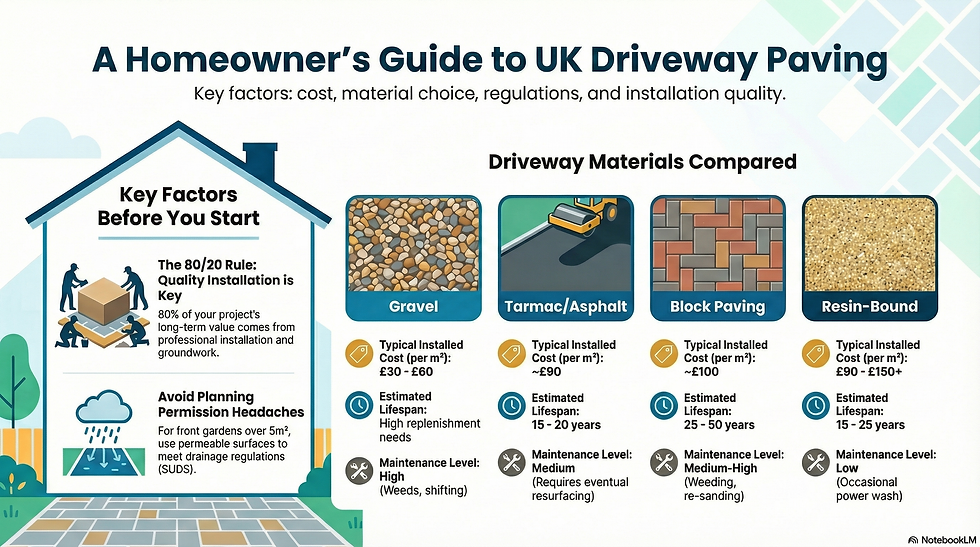
Here is the foundational truth of any paving project: 80% of its long-term success is determined by the quality of the unseen groundwork and installation, while only 20% is attributable to the surface materials you choose. While it's natural to focus on the cost of the beautiful block pavers or sleek resin you've selected, the surprising reality is that this is the least critical part of your investment.
The reason for this is simple: almost all major driveway failures are caused by what lies beneath. Sinking pavers, pooling water, and premature cracking are rarely the fault of the paving material itself. Instead, they are direct results of a poorly prepared sub-base, inadequate drainage, or rushed workmanship. No matter how expensive or high-quality your chosen surface is, it will inevitably fail if laid on a weak foundation.
This principle highlights that the most important decision you'll make isn't which paver to buy, but which installer to hire. As one industry source puts it:
"In our experience, a successful project is made up of 80% installer and 20% product. Even the highest quality products can fail if not installed correctly."
2. The Planning Permission Hack That Saves Time and Money
Many homeowners assume that installing a new driveway in a front garden automatically triggers the need for a complicated and time-consuming planning permission application. This is a common misconception that can add unnecessary stress and cost to a project.
The rule in the UK states that you need planning permission for any new or replacement driveway in a front garden using traditional, impermeable surfaces if the area is larger than five square metres. Impermeable materials like standard concrete or tarmac don't allow water to drain through them, which can increase surface water runoff and contribute to local flooding.
Here is the simple hack to bypass this requirement: use a permeable surfacing material. If you choose a porous material that allows rainwater to drain through it naturally into the ground, you generally do not need planning permission, regardless of the size of your driveway. These materials are compliant with Sustainable Urban Drainage Systems (SUDS) regulations. Examples include:
Gravel
Permeable concrete block paving
Resin-bound surfacing
Choosing a permeable option is a strategic move. It saves you the cost and potential delays of a formal planning application. More importantly, the real financial win is avoiding the significant material and labor costs of installing a separate, expensive engineered drainage system—such as linear drains, underground tanks, or soakaways—which is mandatory for a large, impermeable surface.
3. The Real Cost Driver: It's Not the Materials, It's Your Postcode
When planning a driveway budget, most people focus on the price difference between materials, assuming that choosing a budget paver over a premium natural stone will be the biggest factor in the final bill. While material choice matters, the most significant driver of your total project cost is often something you can't control: your postcode.
Regional labor costs have a massive impact on the price of installation. For example, labor costs in London can be as high as £80 – £120 per square metre, while the same work in the North East might only cost £50 – £75 per square metre. This variance means that the exact same driveway—using the same materials and design—could cost thousands of pounds more in the South East than it would in the North.
To put this in perspective, consider a standard 50m² driveway. In London, where labor costs can reach £80–£120/m², the installation fee alone could be between £4,000 and £6,000. For the exact same job in the North East, with labor at £50–£75/m², the cost would be just £2,500 to £3,750. That’s a potential difference of over £2,000 for the exact same work, proving that where you live can impact your budget more than what you lay.
Furthermore, there is a secondary counter-intuitive cost driver: design complexity. A complex layout with curves, intricate patterns, or multiple levels dramatically increases labor time for cutting and fitting. As a result, a driveway with a complex design using cheaper materials can often end up costing more than a simple, straightforward layout using premium materials, because the savings on the product are completely erased by the higher labor bill.
4. Why the Cheapest Driveway Now is Rarely the Cheapest in the Long Run
It's tempting to choose the driveway option with the lowest upfront price, but this can be a costly mistake in the long term. A true cost assessment requires looking at the Total Cost of Ownership (TCO), which includes not only the initial installation price but also the ongoing maintenance costs and the material's expected lifespan.
A simple comparison between two popular materials illustrates this point perfectly:
Gravel: As the cheapest driveway option, gravel has an attractive upfront installed cost starting from around £30-£60 per square metre. However, its TCO is high. Gravel requires constant, ongoing maintenance, including frequent raking to keep it level, weeding to prevent growth, and topping up the stones as they get displaced or break down over time.
Resin-Bound: This is a mid-to-premium option, with installed costs typically ranging from £80 to £150 per square metre. In contrast to gravel, its TCO is very low. Resin-bound surfaces are extremely low-maintenance, usually requiring nothing more than an occasional power wash to stay looking new. With a lifespan of 15-25 years, it provides long-term performance with minimal ongoing expense.
The 'cheapest' driveway is often the one you only have to pay for once. Prioritizing low long-term maintenance over a low initial price tag is the hallmark of a savvy homeowner.
5. The Gold Standard for Protecting Your Investment
Given that the "80/20 rule" proves installation quality is the single most important factor for a long-lasting driveway, how can you eliminate that risk? The industry's answer is clear: hire a contractor who is part of a manufacturer-accredited scheme.
The leading example of this in the UK is the Marshalls Register of Accredited Landscape Contractors. These installers are not employed by Marshalls; they are independent, accredited professionals who are regularly assessed to ensure their work meets the manufacturer's exacting standards.
The key benefit of using an accredited installer is access to a comprehensive guarantee that protects your investment. The Marshalls Hard Landscape Guarantee covers not only material defects for 10 years but, crucially, it covers installation defects for 5 years. This directly addresses the biggest risk in any paving project.
This is incredibly valuable because it protects you against the "80% risk factor" of poor workmanship. If your driveway fails due to an installation error within five years, the guarantee ensures it will be fixed. This provides a level of peace of mind that non-accredited installers simply cannot match, effectively turning your driveway installation from a gamble into a secured investment.
Conclusion: A Smarter Investment in Your Home
A successful driveway project is built on a foundation of smart decisions, not just a bed of hardcore. The journey to a stunning and durable driveway requires looking beyond the surface-level appeal of paving stones and focusing on the foundational elements that truly matter: installation quality, long-term value, and regulatory compliance. By understanding that the installer is more important than the material and that total cost of ownership trumps upfront price, you can avoid common pitfalls and ensure your project is a resounding success.
Ultimately, a great driveway isn't just an expense; it's an investment that pays you back in curb appeal and peace of mind for decades. The smartest choice is to invest not just in the driveway you can see, but in the expertise you can trust.
Unlock Our Insider Tips and Best Practices
Get the knowledge you need to succeed. Watch our comprehensive video guide filled with essential information and practical tips designed to help you make the most of our services/platform.
✓⃝ Essential information you can revisit anytime
✓⃝ Step-by-step guidance and practical examples
✓⃝ Save time by learning from industry experts
Easily Compare & Book
Describe your path project and we’ll match you with local pros ready to help, quickly and hassle-free.
Paving, Gravel, Stone & More
Get expert help for everything from decorative paths to practical access routes.
Fast, Simple Quotes
Fill in a short form and receive up to 3 competitive quotes so you can choose the right path specialist for your project.
Expert Tips & Design Ideas
Explore layout advice, material guides, and maintenance tips to create long-lasting and attractive pathways.
Popular services

Plumber

Electrician

Roofer

Builder

Gardener

Painter

Landscaper

Handyman

Locksmith
What People Are Saying About NearMeTrades
“I posted one job and got three quotes the same day. It saved me so much time!”
John S. (Landlord)
What People Are Saying About NearMeTrades
“It took just 2 minutes to find a tradesperson who came the same day, absolutely brilliant.”
Alex W. (Homeowner)
What People Are Saying About NearMeTrades
“NearMeTrades helped me find a reliable tradesperson within hours, super easy!”
Emily A. (Homeowner)
Guides & How-tos
c3dc597f-f60d-46c0-964d-e16cdd87c13d